
Understanding DePIN
DePIN, short for Decentralized Physical Infrastructure Network, is one of the most exciting new frontiers in Web3 and the real-world asset (RWA) ecosystem.
At its core, DePIN merges blockchain technology with physical infrastructure, allowing individuals, not corporations, to own, operate, and profit from essential networks like connectivity, storage, and computing power.
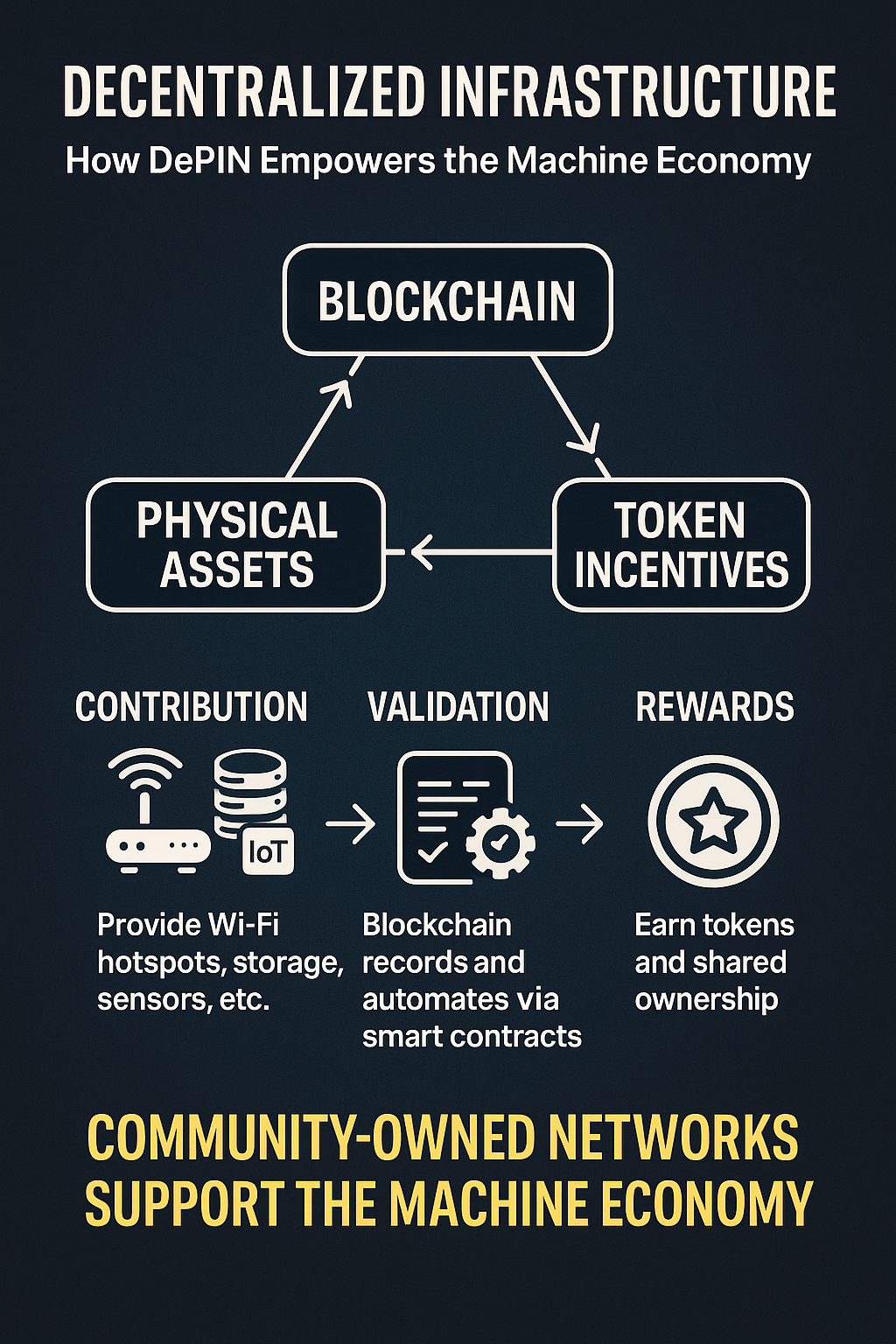
Instead of relying on a centralized company to build and maintain infrastructure, DePIN creates a decentralized, community-powered model. Participants provide real-world assets, such as Wi-Fi hotspots, environmental sensors, or energy nodes, and earn tokenized rewards through smart contracts for contributing to the network.
This approach transforms traditional industries like telecommunications, energy, and logistics by distributing ownership and profit among everyday users.
How DePIN Works
The mechanics behind DePIN are simple but powerful:
- People contribute physical resources such as routers, solar panels, or data storage.
- A blockchain ledger verifies these contributions and automatically issues token rewards.
- Smart contracts ensure transparency, accuracy, and fairness—no middlemen required.
Over time, these contributions combine into large-scale networks that grow organically through community participation rather than corporate funding.
Example: Decentralized Wi-Fi (Helium Network)
Imagine you install a Wi-Fi hotspot in your neighborhood that connects local IoT devices, smart meters, scooters, or delivery drones.
Each time those devices use your connection, the blockchain verifies your contribution and automatically rewards you with tokens.
There’s no telecom company managing this. Instead, you and thousands of other contributors co-own and co-run the network. This model, pioneered by projects like Helium, illustrates DePIN’s potential to transform industries by redistributing power and profit.
Why DePIN Is a Game-Changer for Traditional Business
| Traditional Model | DePIN Model |
| Owned and operated by a single corporation | Owned collectively by contributors |
| High infrastructure costs and limited scalability | Scalable through community participation |
| Opaque operations with little transparency | Transparent on-chain ledger and open data |
DePIN flips the traditional infrastructure model upside down.
Networks grow organically, fueled by user participation rather than capital-heavy corporations. Blockchain ensures trust and accountability, while token incentives create a self-sustaining economic system that rewards every contributor.
Key Benefits of DePIN
Scalability
As more participants contribute hardware, networks expand without centralized bottlenecks.
Transparency & Trust
Blockchain records every contribution and reward, providing total visibility for users and regulators alike.
Inclusivity
Anyone with a compatible device can join, creating a truly democratic infrastructure economy.
Picture a global energy grid powered by community solar panels or a data storage network using idle home servers. DePIN decentralizes ownership and democratizes access to the infrastructure that keeps the digital and physical world running.
DePIN in the UAE: Building the Machine Economy
The United Arab Emirates is among the first nations to actively explore and regulate DePIN applications. Through the Machine Economy Free Zone (MEFZ)—a collaboration between peaq Network and Pulsar Group, the UAE is creating the world’s first sandbox dedicated to decentralized infrastructure.
What’s Happening in MEFZ
The initiative focuses on four key pillars: Regulation, Deployment, Investment, and Innovation.
Here are some of the real-world DePIN pilots being developed in the UAE:
- Air quality monitoring using wearable sensors shared by residents.
- Hyperlocal weather stations built from community IoT devices.
- Virtual power plants powered by solar homes and electric vehicles.
- Noise pollution mapping aggregated from smartphone sensors.
MEFZ is also testing two groundbreaking concepts:
Machine Tokenization – Turning high-value machines (like drones or robots) into tokenized assets that people can co-own.
Universal Basic Ownership (UBO) – A model where communities earn revenue from machine-generated income, ensuring automation benefits everyone—not just corporations.
By creating a regulated innovation hub, the UAE is setting the foundation for a future where humans and machines co-own, co-create, and co-govern digital infrastructure.
Why DePIN Matters Globally
DePIN has the potential to revolutionize how societies build and share essential infrastructure.
By enabling community ownership and token incentives, DePIN:
- Reduces reliance on monopolies and centralized authorities.
- Lowers entry costs for startups and communities.
- Boosts global transparency and inclusivity.
- Aligns innovation with shared value creation.
Whether it’s powering EV networks, expanding rural internet, or monetizing unused computing power, DePIN opens doors to a new, equitable infrastructure model, one where everyone can participate and benefit.
The UAE’s Vision for a DePIN-Driven Future
Through MEFZ, the UAE is proving that decentralized physical infrastructure isn’t just theory—it’s a working model.
By combining clear regulation, blockchain transparency, and community ownership, the UAE is pioneering a framework that could inspire nations worldwide.
This marks the beginning of the Machine Economy, where human ingenuity and decentralized networks work hand in hand to create sustainable, scalable, and community-driven infrastructure systems.
To Summarize
DePIN = Blockchain + Physical Infrastructure + Token Incentives.
- Example: Decentralized Wi-Fi networks like Helium, where users earn tokens for contributing coverage.
- Impact: Democratizes infrastructure, scales faster, and improves transparency.
- UAE in Action: The Machine Economy Free Zone is testing real-world DePIN apps, including environmental sensors and machine tokenization.
- Vision: A future where humans and machines co-own, co-operate, and co-benefit from shared networks.
Suggested Internal Links