The UAE has long been at the forefront of Islamic finance, blending tradition with innovation to create a robust and ethical financial ecosystem.
One of the most influential instruments driving this success is Sukuk, often described as the Islamic equivalent of bonds. However, Sukuk are much more than that. They represent a unique fusion of faith-based principles and modern financial sophistication, designed to align profit with purpose.
What Is Sukuk?
Sukuk, commonly known as Islamic bonds, differ fundamentally from traditional bonds because they comply with Sharia (Islamic law). While conventional bonds generate returns through interest payments, known as riba, this practice is strictly prohibited in Islam. Sukuk, instead, represent fractional ownership in tangible assets or projects that generate profits lawfully under Islamic finance principles.
In essence, when an investor purchases Sukuk, they are buying a share of an asset, not lending money. Returns are derived from the profits or rental income that the underlying asset generates, rather than from fixed interest payments.
This ethical and asset-backed structure makes Sukuk a cornerstone of Islamic finance, which continues to expand rapidly across the Middle East and beyond, with the UAE emerging as one of its global hubs.
How Sukuk Works
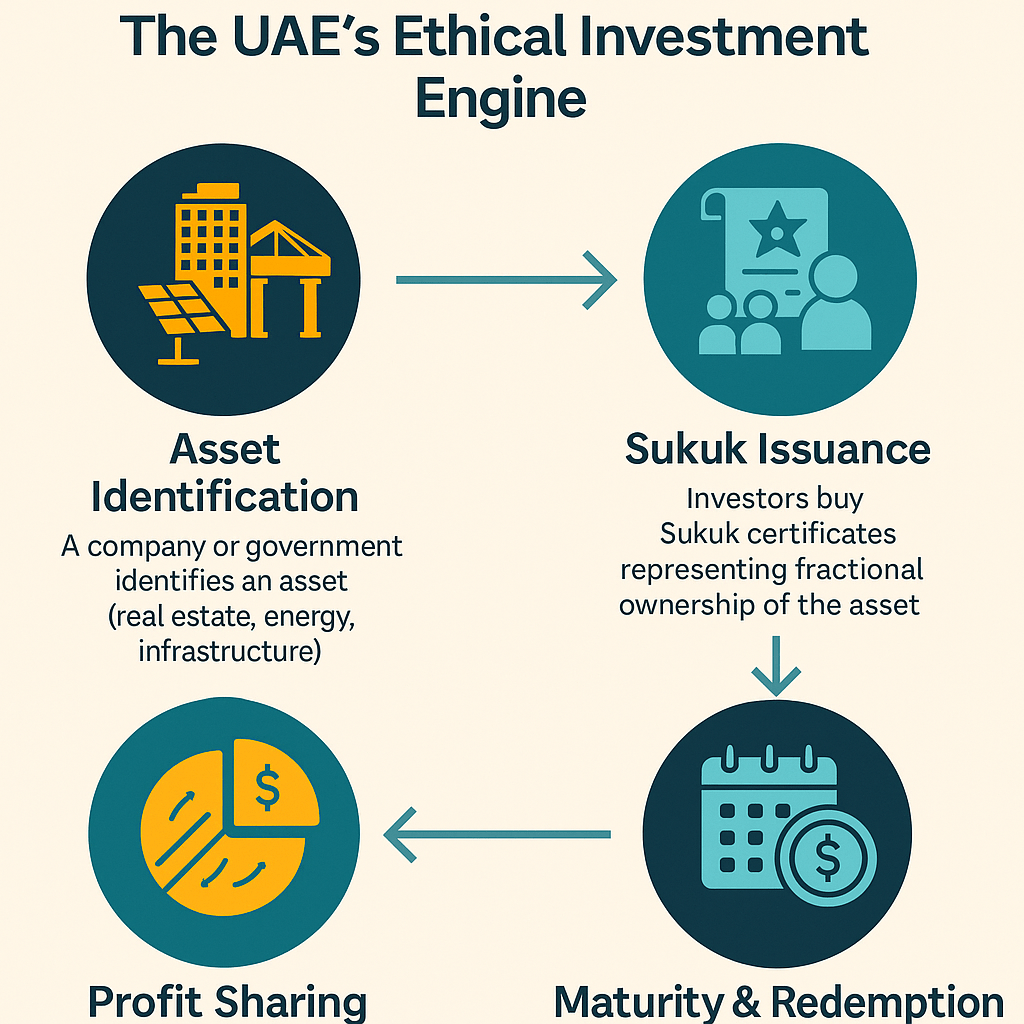
The Sukuk process is built on transparency, shared risk, and asset-based value. A company or government identifies an asset, such as a real estate project, energy infrastructure, or transportation facility, and issues Sukuk certificates backed by that asset.
Investors purchase these certificates, effectively becoming co-owners in the venture. Instead of receiving interest, they earn returns from the profits or rental income generated by the project. When the Sukuk matures, the issuer repurchases the asset or redeems the certificates, returning the investors’ principal.
For example, a UAE developer might issue Sukuk backed by a new commercial tower in Dubai. Investors receive periodic profit distributions from the building’s rental income. Upon maturity, the principal investment is returned, providing both profit and capital protection.
Types of Sukuk in the UAE
The UAE financial market accommodates several Sharia-compliant Sukuk structures, each tailored to specific needs and industries.
The most common include:
Ijara Sukuk
which are lease-based and provide returns from rental income on tangible assets.
Murabaha Sukuk
structured around cost-plus sales, where profits are generated from reselling assets at a pre-agreed markup.
Mudaraba Sukuk
based on partnership models where investors provide capital and entrepreneurs contribute expertise, sharing profits accordingly.
Wakala Sukuk
where an agent (wakil) manages investments on behalf of investors in approved Sharia-compliant ventures.
These models allow both government and corporate issuers to raise capital ethically, while offering investors a range of asset-linked, low-risk investment options.
Why Sukuk Are Popular in the UAE
The UAE’s position as a global Islamic finance hub has made Sukuk one of the most sought-after investment products in the region. Their appeal lies in several key advantages.
Firstly, Sharia compliance ensures ethical investing, avoiding interest-based or speculative activities. This aligns perfectly with the values of Muslim investors seeking faith-driven financial instruments.
Secondly, government backing has bolstered trust and adoption. Both federal and emirate-level authorities, including Dubai, Abu Dhabi, and Sharjah, have issued Sukuk to fund infrastructure, education, and green initiatives.
Thirdly, Sukuk’s global accessibility attracts international investors looking for exposure to the UAE’s dynamic, asset-rich markets. Because Sukuk are backed by tangible assets, they offer stability and real-world value, unlike many speculative financial products.
According to the Islamic Financial Services Board (IFSB), global Sukuk issuances have exceeded $800 billion, with the UAE consistently ranking among the top issuers. A true testament to its leadership in sustainable and ethical finance.
The Benefits for Investors
Sukuk investments appeal to both ethical and pragmatic investors.
They offer steady cashflows from profit-generating projects while maintaining low volatility compared to equities. Investors also gain portfolio diversification through exposure to real-world assets such as real estate, energy infrastructure, and logistics developments, all key sectors of the UAE’s economy.
Beyond financial returns, Sukuk provide the assurance that investments are free from riba, excessive risk, and unethical industries. This balance of profitability and principle has positioned Sukuk as an attractive alternative for global investors seeking sustainable and transparent instruments.
Sukuk vs Conventional Bonds
While both instruments raise capital, their foundations differ sharply.
Traditional bonds are debt instruments; the issuer borrows funds and repays them with interest. Sukuk, however, are ownership instruments, representing proportional shares in assets or ventures.
In Sukuk, risk and reward are shared between issuer and investor, fostering a more balanced, partnership-based approach. Moreover, because Sukuk are asset-backed, they are generally considered more secure, offering protection against default and speculative losses.
Sukuk in the UAE Today
The UAE’s Sukuk market continues to evolve, reflecting the nation’s commitment to financial innovation and sustainability.
Government bodies have issued large-scale Sukuk to fund infrastructure, renewable energy, and transport projects, supporting national goals. For instance, the UAE Vision 2031 and Net Zero 2050.
Corporations, including real estate developers, airlines, and banks, are also leveraging Sukuk for capital raising, a move that underscores the private sector’s confidence in this structure.
A particularly promising development is the rise of Green Sukuk, which finances environmentally friendly projects such as solar parks and sustainable urban developments. This aligns perfectly with the UAE’s drive toward environmental stewardship and responsible investing.
Our thoughts
Sukuk investments represent more than just a financial instrument; they embody the UAE’s philosophy of aligning faith, ethics, and economic progress.
By allowing investors to participate in real, productive, and Sharia-compliant ventures, Sukuk create a win-win model for both issuers and investors. They offer stable returns, diversified opportunities, and the reassurance of ethical integrity.
As the UAE cements its role as a global capital for Islamic finance, Sukuk will continue to be a key driver of economic development. Funding the nation’s infrastructure, supporting sustainable growth, and connecting investors to a purpose-driven financial future.
Sukuk are not just about investing in assets; they are about investing in values. A principle that lies at the very heart of the UAE’s evolving financial landscape.