
The UAE is already one of the world’s fastest-growing hubs for Web3 and blockchain innovation. Now, a new sector is emerging at the intersection of fitness, gaming, and digital finance — Move-to-Earn (M2E).
M2E applications reward users for physical activity, walking, running, and cycling, by converting movement data into digital tokens or NFTs. For a country investing heavily in smart cities, health tech, and Web3 infrastructure, the M2E movement presents a natural extension of the UAE’s digital-first vision.
What Is Move-to-Earn (M2E)?
Move-to-Earn (M2E) is a blockchain-based model where users earn cryptocurrency or digital rewards for completing real-world physical activities.
It uses wearable devices or smartphone sensors to track motion data, which is then verified and recorded on-chain. In return, users receive tokens that can be traded, staked, or used for in-app benefits — merging the fitness economy with the digital asset ecosystem.
This model builds on the Play-to-Earn (P2E) trend but shifts focus from gaming to real-world wellness and productivity. In short, it rewards users for taking care of their health while contributing to a data-driven fitness ecosystem.
How M2E Works
Behind every M2E platform lies a combination of blockchain technology, sensors, and game theory.
Tracking
Activity data is captured using GPS, motion sensors, or smart devices.
Verification
The system authenticates the data on-chain, ensuring accuracy and preventing fraud.
Rewarding
Tokens or NFTs are issued based on performance or milestones.
Utility
Rewards can be used for staking, trading, or unlocking premium features within the ecosystem.
The value of M2E tokens depends on demand, utility, and tokenomics, much like other DeFi and gaming projects. Some platforms also introduce “energy” systems or limited earning sessions to balance sustainability with profitability.
Why the UAE Is Perfect for M2E Expansion
The UAE’s strategic focus on health, innovation, and tourism makes it an ideal testing ground for Move-to-Earn ecosystems.
Smart Cities
Dubai and Abu Dhabi already integrate IoT data, 5G networks, and AI to build connected urban ecosystems, the perfect foundation for M2E tracking infrastructure.
Health & Wellness Initiatives
National programs like the Dubai Fitness Challenge encourage citizens to stay active, offering a ready-made audience for M2E adoption.
Crypto Regulation & Adoption
The UAE’s clear frameworks under VARA and ADGM attract global blockchain projects and ensure legal clarity for Web3-based platforms.
Tourism
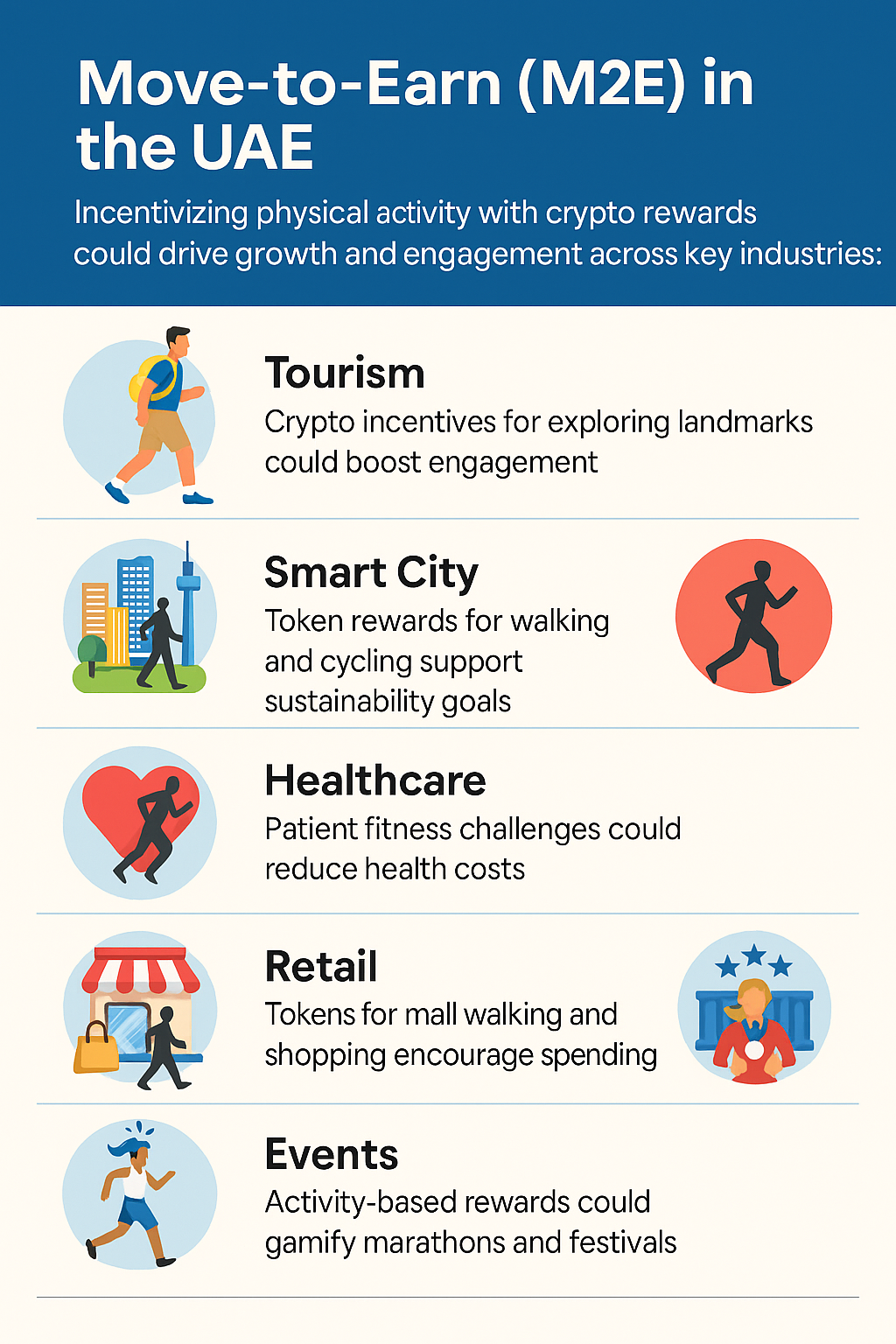
With over 17 million annual visitors, integrating M2E apps into attractions, malls, and hospitality venues could gamify tourism experiences.
M2E in Action: Global Examples
To understand the UAE’s potential, it’s useful to look at successful global M2E projects:
STEPN
The most recognized M2E app where users earn GMT tokens for walking, jogging, or running using NFT sneakers.
Genopets
Combines M2E mechanics with gamified “digital pets” that evolve based on the user’s activity.
Sweatcoin
Focuses on mainstream adoption by converting physical steps into tokens redeemable for real-world rewards.
These projects have already onboarded millions of users globally, proving that physical activity can be transformed into digital value. For the UAE, this could mean a new class of startups blending fitness, finance, and tourism engagement.
Business Opportunities in the UAE
Retail & Malls
Retailers can integrate M2E apps with loyalty programs, rewarding users who visit stores or complete step challenges within malls.
Tourism & Hospitality
Hotels, resorts, and attractions can gamify guest experiences, rewarding visitors for exploring cultural landmarks or completing activity routes.
Fitness & Health Sector
Gyms, sports clubs, and wellness centers can integrate M2E rewards into membership models, turning exercise into a tokenized engagement tool.
Events & Corporate Wellness
M2E can be used in public events and corporate settings to boost engagement, promote wellness, and measure participation transparently.
Challenges to Consider
While the potential is enormous, M2E still faces hurdles that must be addressed for long-term sustainability:
Token Inflation
If too many tokens are minted, the value can drop rapidly.
User Verification
Preventing cheating or GPS spoofing is critical.
Privacy & Data Ownership
Ensuring activity data remains user-controlled will be key to regulatory acceptance.
Adoption Fatigue
Like most Web3 models, user retention depends on balancing financial incentives with real utility.
With proper governance, partnerships, and token design, these challenges can be mitigated — paving the way for large-scale institutional adoption in the UAE.
How UAE Businesses Can Get Involved
Collaborate with M2E Startups
Partner with global platforms or local innovators to integrate M2E rewards into loyalty systems.
Adopt Tokenized Wellness Programs
Incentivize staff to stay healthy through corporate Move-to-Earn challenges.
Launch Branded M2E Campaigns
Use NFTs, tokens, or on-chain rewards to enhance customer engagement and retention.
Build Infrastructure
Encourage telecom, fintech, and IoT firms to support M2E data collection and blockchain connectivity.
The Road Ahead
Move-to-Earn represents more than just a fitness trend; it’s a new economic model where health, data, and finance intersect.
For the UAE, M2E aligns perfectly with its vision of becoming a global Web3 innovation hub, driving participation, health awareness, and digital economic growth. As blockchain adoption expands across sectors, M2E could soon become a natural part of the UAE’s everyday life, from smart city streets to fitness apps and tourism experiences.
Key Takeaway
The future of fitness, loyalty, and engagement is tokenized, and the UAE is poised to lead this global movement.