The UAE real estate market continues to stand as one of the most dynamic and sought-after in the world. Cities like Dubai and Abu Dhabi attract global investors with their record-breaking luxury developments, futuristic infrastructure, and ambitious smart city projects. Yet, for developers, one persistent challenge remains: securing efficient funding for large-scale developments without the delays and constraints of traditional financing.
Enter Real-World Asset (RWA) tokenization. A financial innovation that is transforming how property developers raise capital, attract global investors, and accelerate construction timelines. By turning physical assets into digital tokens, developers can open new doors to liquidity, transparency, and cross-border participation in the UAE’s booming real estate sector.
What is RWA Tokenization in Real Estate?
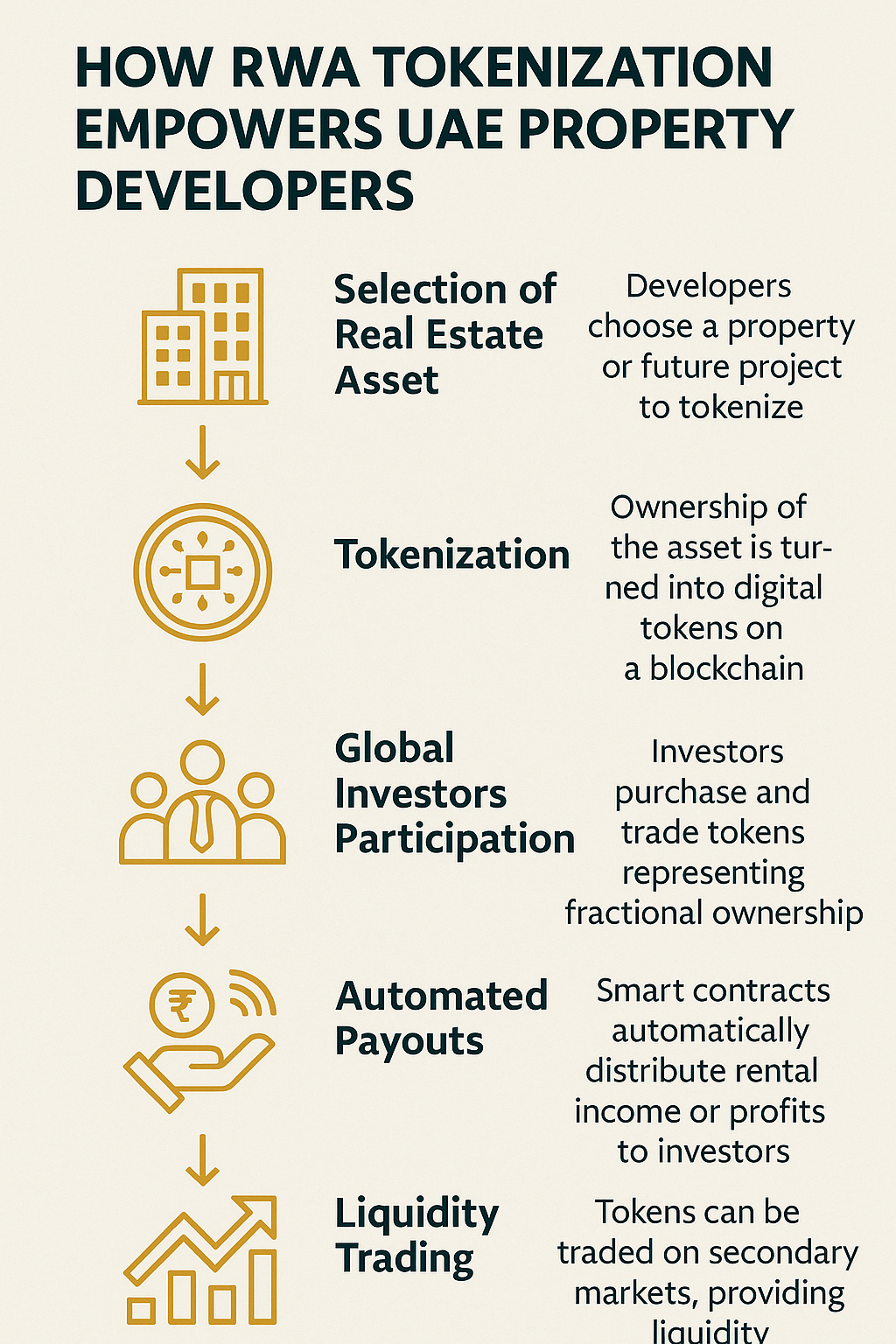
At its core, RWA tokenization involves converting ownership of a physical asset, such as a property or future development, into digital tokens recorded on a blockchain.
Each token represents a share of ownership, allowing investors to buy, sell, and trade those fractions easily.
The simplest way to understand real estate tokenization is to think of it as one token representing one share of ownership in the underlying property. Each token acts like a digital certificate of ownership, allowing investors to hold, trade, or receive income from a fraction of the asset, just as shareholders benefit from owning a portion of a company.
This means that a luxury apartment building or commercial complex can be divided into millions of digital tokens, giving both institutional and retail investors a stake in high-value developments that were once out of reach.
These tokens can then be traded on regulated digital marketplaces, offering liquidity and accessibility rarely seen in the traditional property market.
For developers, this technology provides a faster and more flexible alternative to bank loans or pre-sales, reducing dependency on traditional intermediaries while expanding access to capital from investors around the world.
How UAE Developers Can Use RWA to Build Faster
Raising Capital More Efficiently
Traditional financing models often rely on slow-moving bank approvals, high-interest loans, or lengthy pre-sale campaigns. With tokenization, developers can fractionalize ownership of their projects and sell these digital shares directly to investors globally.
For example, a AED 1 billion waterfront project could be tokenized into 100 million shares valued at AED 10 each. This approach opens participation to thousands of small investors across Asia, Europe, and Africa, enabling rapid capital formation without waiting for traditional institutional commitments.
This democratized model of fundraising can help developers break ground sooner and scale multiple projects simultaneously, aligning perfectly with the UAE’s fast-paced real estate growth strategy.
Expanding the Global Investor Pool
RWA tokenization removes geographical and financial barriers that once restricted foreign participation. Global investors can now purchase fractional stakes in Dubai or Abu Dhabi developments directly through compliant blockchain platforms, without the logistical complexities of property transfers or local banking hurdles.
Initiatives like Prypco Mint, launched in collaboration with the Dubai Land Department (DLD), already allow investors to own fractional shares in tokenized villas and apartments. This innovation has positioned the UAE as a world leader in regulated tokenized real estate, driving confidence among both developers and investors.
Improving Liquidity and Investor Confidence
Traditional real estate investments are known for being illiquid; once funds are committed, investors may wait years for returns or exits. Tokenization changes this completely by allowing investors to trade their property-backed tokens 24/7 on secondary markets.
For developers, this increased liquidity attracts more buyers and provides stronger market stability. For investors, it brings flexibility, transparency, and a sense of security through on-chain proof of ownership.
Automating Rental Income and Dividends
Through smart contracts, developers can automate payments such as rental income or profit-sharing directly to token holders. This removes the need for intermediaries like banks or auditors and ensures real-time, tamper-proof transactions.
For instance, tokenized commercial properties can distribute monthly rental income directly to investors’ digital wallets. This not only reduces administrative costs but also enhances trust, an essential factor in global property investment.
Unlocking Faster Project Timelines
With immediate access to tokenized capital, developers can begin construction earlier, accelerate project completions, and manage multiple developments concurrently. This agility supports the UAE’s broader vision under Dubai Economic Agenda (D33) and Operation 300Bn, where innovation, speed, and scalability are key to national growth.
Why the UAE is Perfect for RWA Real Estate
The UAE’s commitment to blockchain integration, transparent regulation, and foreign investment makes it the ideal environment for RWA innovation.
Government entities such as the Dubai Land Department (DLD) and the Virtual Assets Regulatory Authority (VARA) already support tokenized real estate through initiatives like Real Estate Self-Transaction (REES) and blockchain-based registries.
These frameworks ensure investor protection, compliance, and market stability, critical elements for mainstream adoption.
Furthermore, the UAE’s global investor appetite, world-class infrastructure, and robust digital economy create the perfect ecosystem for developers seeking capital efficiency and global reach.
The Future: Tokenized Cities and Smart Infrastructure
Looking ahead, tokenization will extend beyond residential and commercial properties. Developers could soon tokenize infrastructure assets such as renewable energy systems, data centers, EV charging stations, and smart utilities, aligning with the UAE’s Net Zero 2050 and smart city initiatives.
Imagine owning fractional shares in an autonomous transport network or a solar-powered smart district. Such models will blur the lines between real estate investment and technological innovation, transforming how cities are built and financed.
Our thoughts
RWA tokenization is more than just a financial instrument; it’s a new growth paradigm for the UAE’s property market. By digitizing ownership, developers gain access to faster funding, global investors, and transparent financial systems that inspire trust.
As blockchain adoption accelerates, developers who embrace tokenization early will position themselves ahead of the curve. The UAE is capable of financing projects in days, not months, and delivering innovative developments that attract investors worldwide.
The UAE is already a beacon for digital transformation and real estate excellence. With RWA tokenization, it can now lead a new era of decentralized property investment, where ownership is open, global, and liquid.