In an era defined by decentralization and digital transformation, a new technological movement is reshaping how societies build and manage infrastructure.
Known as DePIN, short for Decentralized Physical Infrastructure Networks, this emerging Web3 model has the potential to redefine the foundations of global industry, from energy and telecommunications to logistics, real estate, and artificial intelligence.
The UAE, already a global pioneer in smart cities, renewable energy, and blockchain innovation, stands at the perfect intersection to lead this revolution. By adopting DePIN, the Emirates can position itself as a blueprint for the next generation of community-driven, token-incentivised infrastructure.
So, what is DePIN?
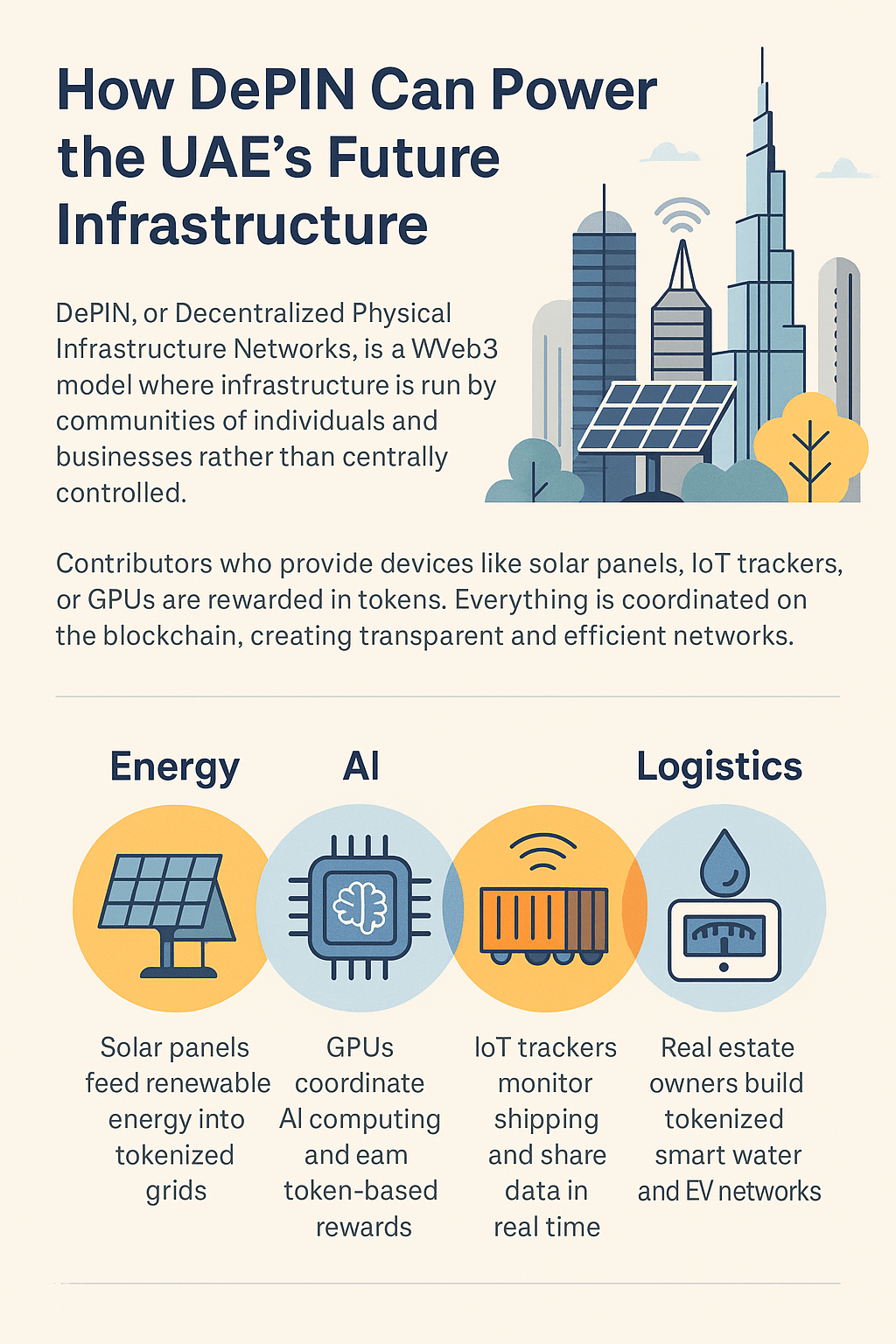
At its core, DePIN transforms traditional infrastructure into community-powered networks. Instead of relying on a single company or government entity to build, own, and control infrastructure, DePIN allows thousands of individuals and businesses to contribute directly to physical networks.
Participants deploy devices such as Wi-Fi routers, solar panels, data servers, or electric vehicle chargers. These devices are then connected through blockchain technology, which coordinates usage, verifies data, and automatically distributes rewards. Contributors earn tokens based on the value they provide, while users pay to access the network’s services.
The result is an open, transparent, and self-sustaining system where physical infrastructure grows organically through shared ownership and digital incentives.
In simple terms, DePIN is the Web3 evolution of real-world infrastructure, turning systems that were once centralised and capital-intensive into community-operated networks powered by blockchain coordination and smart contracts.
How DePIN Works in Practice
The operation of DePIN relies on the seamless integration of physical devices and blockchain logic.
Individuals or companies deploy devices that serve practical functions such as providing internet access, storing data, or generating renewable energy. The blockchain acts as the coordinator and accountant, ensuring that every contribution is tracked and every reward distributed fairly.
Tokenization makes this model viable. Contributors earn tokens for powering the network, while users spend them to access services, creating a closed-loop ecosystem. Over time, the value of these tokens grows in tandem with network adoption, transforming contributors into stakeholders in the infrastructure they help build.
Several projects already demonstrate DePIN’s power.
Helium Network rewards users for deploying Wi-Fi hotspots.
Filecoin and Arweave decentralize storage by paying participants to offer hard drive space.
Render Network connects GPU owners who contribute computing power for AI and graphics rendering.
Each represents a new way to democratise infrastructure using blockchain coordination.
Why DePIN Is a Game-Changer for the UAE
The UAE’s economic DNA is built around infrastructure. From solar farms and ports to data centers and logistics hubs, the Emirates thrives on large-scale physical networks. DePIN provides an opportunity to connect these industries through decentralized digital coordination, unlocking efficiency, sustainability, and global investment.
In energy and renewables
solar installations across Dubai and Abu Dhabi could feed into blockchain-based power grids. Homeowners and businesses that supply excess energy could be rewarded with DePIN tokens, creating a peer-to-peer green energy marketplace that supports the UAE’s Net Zero 2050 goals.
In telecommunications
decentralized networks like Helium could complement national infrastructure by crowdsourcing IoT sensors and Wi-Fi nodes, enhancing connectivity in smart cities, airports, and logistics zones.
In logistics and supply chain management
blockchain-linked IoT devices can record shipment data in real time. Anything from cargo location to temperature, increasing transparency across ports and warehouses.
In real estate and smart cities
property developers could tokenize infrastructure such as EV chargers, water systems, or environmental sensors. Residents would not only use these utilities but also earn from them, creating self-sustaining digital communities aligned with Dubai’s Smart City strategy.
In AI and data infrastructure
platforms like Render enable GPU owners to contribute to global AI training. With the UAE investing heavily in AI leadership, DePIN could lower computing costs while decentralising the supply of AI resources, a key step toward digital sovereignty.
Why the UAE Is the Perfect DePIN Hub
Few nations are as well-positioned as the UAE to pioneer the DePIN revolution.
The country’s regulatory frameworks, such as the Virtual Assets Regulatory Authority (VARA) and Abu Dhabi Global Market (ADGM), already support blockchain experimentation under clear and forward-thinking rules.
The UAE’s infrastructure excellence, combined with its role as a global trade and technology hub, creates fertile ground for decentralized infrastructure projects to scale globally.
Moreover, the Emirates’ pro-innovation culture, venture funding ecosystem, and world-class free zones allow startups to develop, test, and deploy DePIN models with unmatched speed and support.
DePIN aligns perfectly with the UAE’s economic diversification agenda under Vision 2031 and the Dubai Economic Agenda D33, both of which prioritise AI, blockchain, and advanced manufacturing as future growth pillars.
What challenges and considerations come into play, you may ask?
While DePIN’s potential is vast, success depends on overcoming practical challenges.
Regulation
must evolve to accommodate decentralized infrastructure ownership and token-based incentives without compromising security or compliance.
Public awareness
is also essential. Citizens, investors, and corporations need education about how to safely deploy devices, earn tokens, and participate in these ecosystems.
Security
is another key factor. Since DePIN involves Internet of Things (IoT) devices, robust encryption and hardware safeguards are critical to prevent data breaches or manipulation.
The UAE’s strong record in cybersecurity and regulatory innovation makes it ideally suited to address these issues while setting global standards for DePIN governance.
Our Thoughts: Why the UAE Should Lead
DePIN is more than a blockchain trend; it represents a fundamental shift in how societies finance, build, and share infrastructure. It merges economic incentives, community participation, and digital transparency into one model that rewards both innovation and contribution.
For the UAE, embracing DePIN means empowering citizens and businesses to co-own the infrastructure that drives their economy. It strengthens sustainability, accelerates smart city initiatives, and enhances financial inclusion, all while reinforcing the nation’s status as a global Web3 and digital economy leader.
If the UAE continues to combine strategic policy with entrepreneurial drive, it can become the global capital of decentralised infrastructure, exporting not only innovation but also a model for equitable, tokenized economic growth.
In the world of Web3, DePIN is the bridge between the physical and digital worlds, and the UAE has everything it needs to lead that transformation.