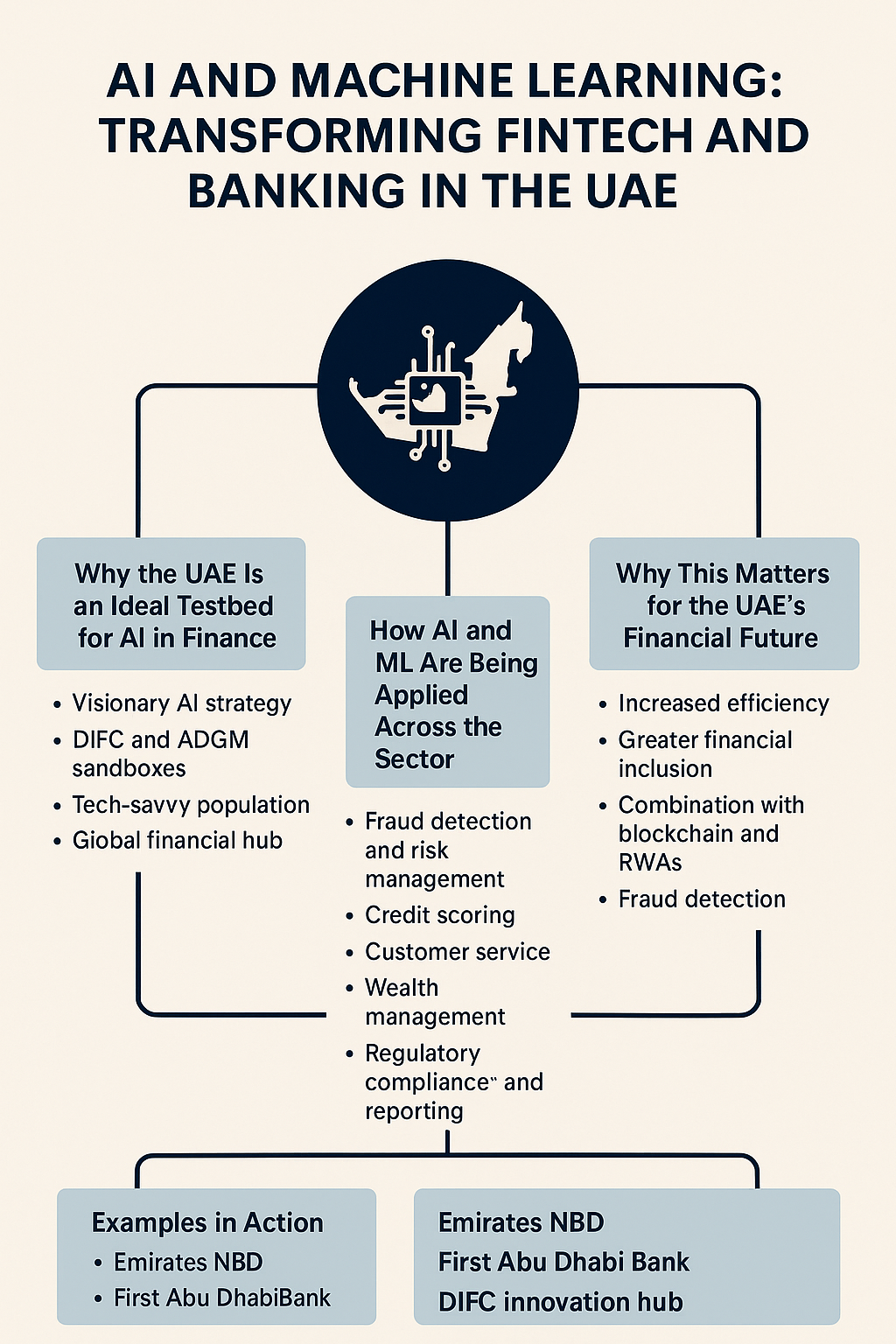

Why the UAE Is an Ideal Testbed for AI in Finance
Few markets are as well-positioned as the UAE to pioneer AI adoption in finance. The country’s National AI Strategy 2031 places artificial intelligence at the heart of its digital transformation agenda, with finance named a top priority sector. Regulatory innovation has kept pace, with the Dubai International Financial Centre (DIFC) and Abu Dhabi Global Market (ADGM) offering fintech sandboxes that encourage experimentation under clear legal frameworks.
The UAE also benefits from one of the most digitally connected and tech-savvy populations in the world. With a young demographic and high smartphone penetration, consumers are eager to engage with digital-first banking experiences. Add to that the country’s role as a global financial hub. Hosting both legacy banks and cutting-edge fintech startups, it becomes clear why the UAE is the perfect testbed for AI-driven financial innovation.
How AI and ML Are Being Applied Across the Sector
AI’s impact on the UAE’s financial industry is far-reaching, reshaping every layer of banking and fintech operations.
Fraud detection and risk management have seen some of the most immediate benefits. Traditional systems rely on static rules that struggle to keep up with complex, evolving threats. By contrast, AI-powered systems use machine learning models that analyse millions of transactions in real time, flagging suspicious patterns or anomalies before losses occur. This proactive approach not only prevents financial crime but also enhances compliance with global anti-money laundering (AML) standards.
Credit scoring is another area being transformed. Traditional models often exclude individuals without established credit histories, a major issue for expatriates and new residents in the UAE. AI-driven credit systems now analyse alternative data such as rent payments, mobile phone usage, and even online behaviour to create more accurate, inclusive credit profiles. This expansion of financial access is helping banks and fintechs tap into previously underserved segments of the population.
In customer service, AI chatbots and virtual assistants are redefining efficiency and accessibility. These systems provide 24/7 multilingual support across Arabic, English, Hindi, and Mandarin, handling everything from balance inquiries to complex financial advice. By automating routine interactions, banks can focus their human teams on delivering high-value services to priority clients.
Wealth and portfolio management are also being democratized through AI. Robo-advisors use machine learning to build tailored investment portfolios based on user preferences, income, and risk tolerance. Services once reserved for private banking clients. This allows retail investors to access sophisticated wealth strategies at a fraction of the traditional cost.
Behind the scenes, AI systems are streamlining regulatory compliance and reporting. Natural language processing (NLP) tools automatically interpret evolving regulations, track compliance metrics, and generate reports for auditors and regulators such as the UAE Central Bank. The result is a more transparent and efficient governance process that reduces human error and operational risk.
Why This Matters for the UAE’s Financial Future
The advantages of AI integration in banking and fintech are clear. Automation increases efficiency and reduces operational costs, while advanced analytics improve decision-making speed and accuracy. Real-time monitoring strengthens cybersecurity and fraud prevention, safeguarding consumers and institutions alike.
AI also supports greater financial inclusion. A key objective for the UAE’s broader economic vision is to open credit and investment access to those historically underserved by traditional banking. This aligns closely with the nation’s commitment to digital transformation, sustainability, and inclusive growth.
Moreover, the combination of AI with other emerging technologies, such as blockchain and real-world asset (RWA) tokenization, positions the UAE at the forefront of fintech innovation. Projects linking AI with tokenized assets and smart contracts are already being piloted in Dubai and Abu Dhabi, hinting at the next evolution of decentralised finance powered by intelligent automation.
Challenges and Considerations
Despite the enormous potential, integrating AI into finance comes with challenges. Data privacy and security remain top priorities, as AI systems depend on vast amounts of sensitive personal and financial data. The UAE’s data protection laws provide strong safeguards, but firms must ensure continued compliance as technology evolves.
Algorithmic bias is another concern. AI models must be trained responsibly to ensure they treat all demographics fairly, especially when determining creditworthiness or financial eligibility. Meanwhile, a shortage of skilled AI professionals remains a bottleneck globally, making talent development a strategic imperative for the region.
Finally, regulators and financial institutions must maintain close alignment to ensure AI systems remain transparent and auditable. As AI models become more complex, maintaining explainability, understanding why an algorithm made a certain decision, will be crucial for both consumer trust and regulatory oversight.
Examples in Action
Leading institutions in the UAE are already proving the value of AI adoption. Emirates NBD has deployed predictive analytics and AI-powered chatbots to enhance customer service and retention. First Abu Dhabi Bank (FAB) uses AI to refine credit profiling and improve risk management. The DIFC innovation hub hosts several AI-driven fintech startups.
Our thoughts
AI and machine learning are transforming fintech and traditional banking in the UAE, turning data into intelligence, transactions into insights, and systems into smart ecosystems. These technologies are not replacing human expertise; they’re amplifying it.
By blending automation with human innovation, the UAE is creating a financial model that is faster, fairer, and more inclusive. The country’s ability to merge regulatory foresight, technological capability, and global capital makes it a living laboratory for the future of finance.
As adoption scales, the UAE will continue to stand out as a world leader in AI-powered banking and fintech, showing how innovation and trust can coexist at the heart of a modern financial system.