
In the fast-evolving world of finance, few sectors are transforming as quickly as regulatory technology, better known as RegTech.
Originally born out of the 2008 financial crisis to help banks comply with growing regulatory demands, RegTech is now stepping into a new frontier: Web3.
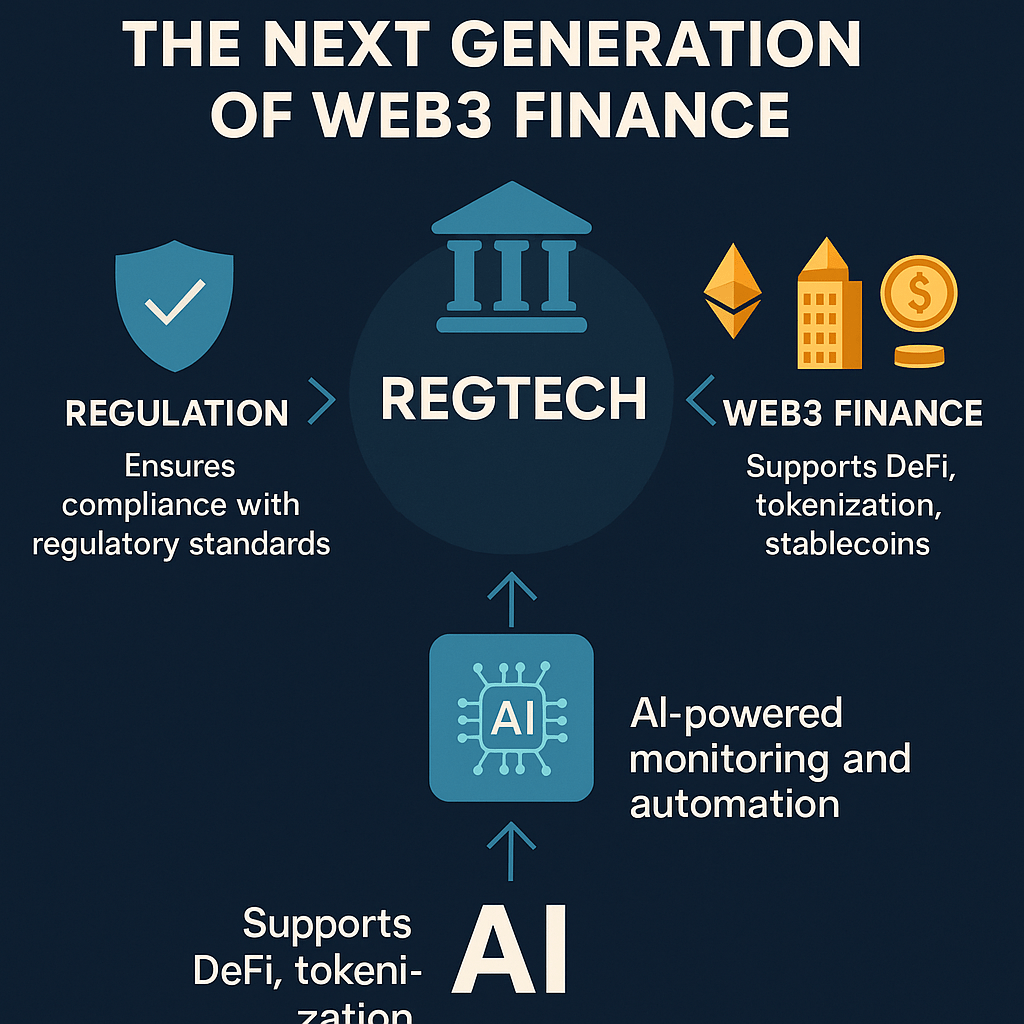
As decentralized finance (DeFi), tokenized assets, and blockchain-based financial systems mature, RegTech is emerging as the bridge between innovation and compliance, the key to making new financial models both scalable and trusted.
What Is RegTech?
RegTech, short for “regulatory technology,” refers to the use of advanced technologies. Such as artificial intelligence (AI), machine learning (ML), and blockchain analytics, to automate and improve compliance processes across the financial system.
In traditional finance, RegTech tools help banks and payment firms manage everything from anti-money laundering (AML) checks and transaction monitoring to risk assessment and reporting.
Instead of relying on manual audits or human oversight, RegTech automates compliance through data analysis and smart algorithms.
In the Web3 world, the same concept applies, but with a far more complex challenge: ensuring compliance across decentralized, borderless, and pseudonymous networks.
Why RegTech Matters for Web3
One of the biggest tensions in Web3 has always been the balance between decentralization and regulation. On one side, users value privacy, autonomy, and permissionless systems. On the other, regulators demand transparency, accountability, and protection against fraud, money laundering, and financial crime.
RegTech offers a way to satisfy both. By embedding compliance tools into blockchain infrastructure, startups and developers can make Web3 applications both compliant by design and scalable in practice.
This is especially critical as institutional adoption grows. Banks, asset managers, and sovereign funds are now exploring decentralized finance and tokenization. However, they can only participate if systems meet legal and audit standards. RegTech ensures that compliance doesn’t have to slow innovation; it can power it.
Why RegTech Is Essential for the Future of Web3 Finance
1. Institutional Trust and Adoption
Without compliance frameworks, institutional players cannot participate in decentralized markets. RegTech enables tokenization platforms, DeFi protocols, and blockchain exchanges to meet the same standards as traditional finance. Once trust is built, liquidity follows.
2. Smart, Automated Governance
In the future, compliance will no longer be an afterthought; it will be a core part of code.
RegTech can integrate directly into smart contracts, allowing automated enforcement of tax rules, securities compliance, or trading limits based on jurisdiction.
3. Global Interoperability
Web3 finance is inherently global, but regulation is not. RegTech tools can translate and synchronize different regulatory frameworks, ensuring that tokenized assets or payment systems comply across borders.
This is a key advantage for platforms operating in regions like the UAE, Singapore, and Europe, which are pioneering regulated digital finance.
4. Fraud Detection and Cybersecurity
AI-powered RegTech can spot suspicious behaviour, prevent wallet hacks, and detect market manipulation faster than human auditors. By combining blockchain transparency with predictive analytics, it enhances overall network resilience.
The Role of RegTech in the UAE’s Web3 Vision
The UAE has rapidly become one of the most forward-thinking nations in integrating technology, regulation, and finance. With entities like the Virtual Assets Regulatory Authority (VARA) in Dubai and the Abu Dhabi Global Market (ADGM) setting global benchmarks for digital asset oversight, RegTech is poised to become a foundational layer in the UAE’s Web3 ecosystem.
In the context of RWA tokenization, AI-driven payments, and stablecoin settlements, RegTech can automate compliance while protecting the UAE’s reputation as a trusted financial hub.
For instance:
Smart Compliance Engines
can ensure tokenized Sukuk or real estate offerings meet both Sharia and financial regulations.
AI-based Monitoring
can help detect cross-border money flows in digital dirham or AE stablecoin ecosystems.
Automated Reporting Systems
can give regulators real-time dashboards of tokenized transactions, improving transparency without slowing innovation.
By embedding RegTech into the infrastructure of digital assets, the UAE can stay ahead of global standards while attracting institutional capital and fintech startups.
The Next Frontier: AI + RegTech in Web3
Artificial Intelligence will amplify RegTech’s power dramatically. AI models can learn from millions of blockchain transactions, continuously improving their ability to identify risk, ensure fairness, and streamline audit trails.
In future Web3 ecosystems, we can expect AI-driven compliance agents operating autonomously, monitoring decentralized applications, enforcing global financial standards, and generating regulatory reports in real time.
This convergence of AI, RegTech, and Web3 is what will make the next generation of finance both trustless and trusted— decentralized in operation, yet transparent and compliant in governance.
Final Thoughts
RegTech isn’t just another fintech buzzword; it’s the missing puzzle piece that allows Web3 to move from the experimental to the institutional era.
By merging smart compliance with decentralized technology, it transforms regulation from a bottleneck into a catalyst.
For startups, it means smoother scaling and global legitimacy.
For investors, it means security and accountability.
For regulators, it means visibility into a transparent, real-time economy.
In short, RegTech is the bridge between innovation and trust, and in the age of AI and Web3, that bridge will determine who leads the financial systems of tomorrow.