
Stablecoins are the financial rails on which the future of global finance will move forward.
To understand where the next wave of digital finance is heading, we need to talk about AE, the UAE’s upcoming stablecoin initiative.
This article explores what AE aims to achieve, why stablecoins are becoming critical to the global financial system, how the United States is building a new on-chain dollar economy, and how the UAE and other nations are positioning themselves to lead in this transformation.
What Is AE, the UAE Stablecoin?
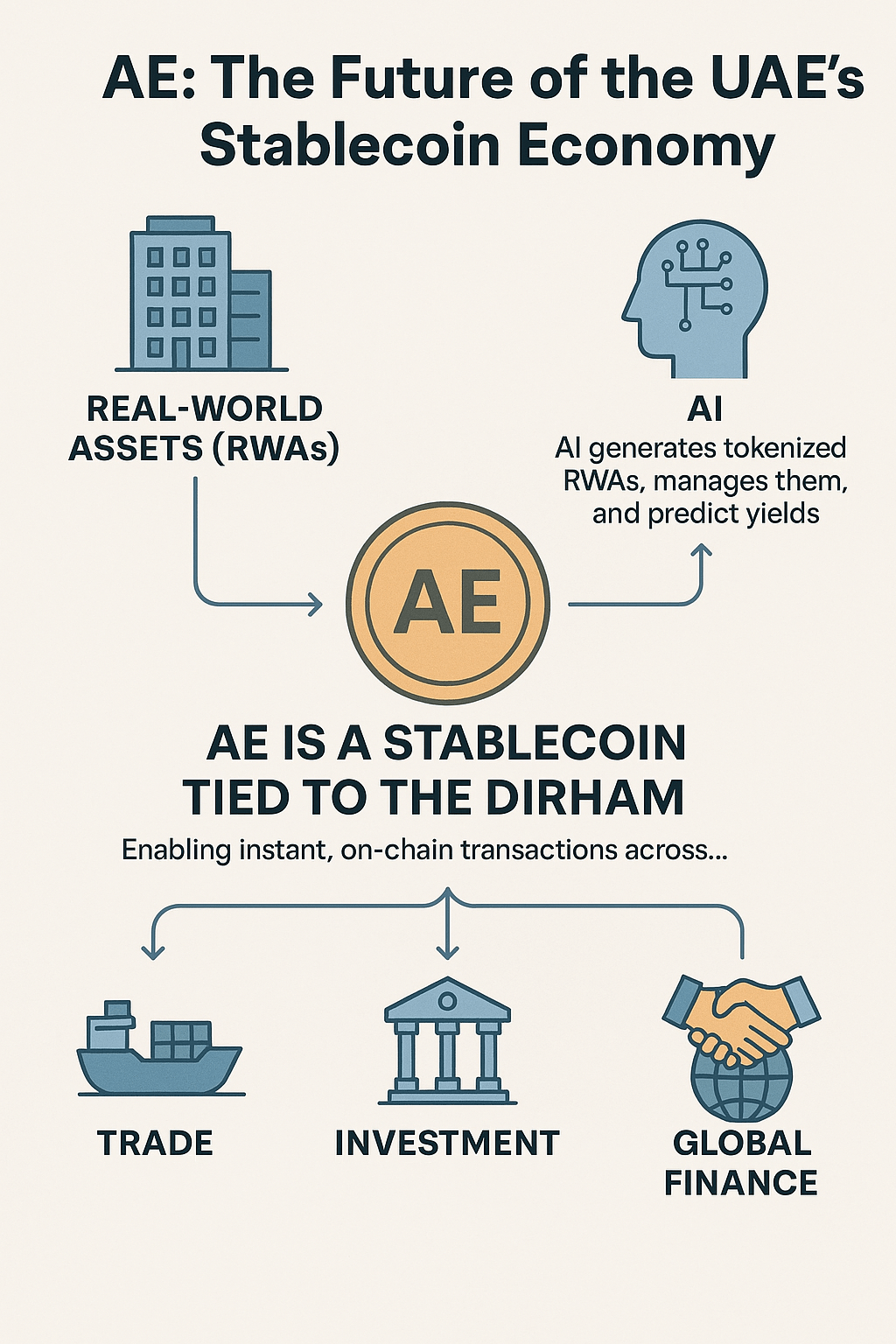
AE is a proposed UAE stablecoin pegged to the dirham and designed to operate as a trusted digital settlement asset across payments, trade, investment flows, and tokenized real-world assets.
Rather than relying on banks, wire transfers, or card networks, AE would enable instant, on-chain transactions fully backed by reserves held in regulated UAE financial institutions. The goal isn’t to create a speculative crypto token but a regulated, digital dirham that businesses, banks, and governments can actually use.
In practice, AE would function as a compliant payment stablecoin, settling transactions between wallets, smart contracts, and even AI agents, while remaining under UAE regulatory oversight.
This vision aligns with the UAE’s growing reputation as a global hub for blockchain, tokenization, and digital finance, led by bodies like Abu Dhabi Global Market (ADGM) and Dubai’s Virtual Assets Regulatory Authority (VARA).
AE could become the default way to settle tokenized trades, real estate deals, and cross-border payments, reducing reliance on legacy banking rails like SWIFT.
Why the UAE Needs a Stablecoin
There are several strategic reasons the UAE is pursuing a sovereign stablecoin. Let’s look at a few.
Speed and Efficiency
A blockchain-based dirham allows real-time settlement, cutting out intermediaries and delays. For a global logistics and trade hub like the UAE, this is a massive competitive edge.
Financial Sovereignty
A national stablecoin gives the UAE control over its own liquidity rails. Instead of depending on offshore banking systems, the UAE could settle energy, real estate, and tokenized asset flows domestically, keeping capital and data within its borders.
Integration with Tokenization
The UAE is already pioneering tokenized real estate and sukuk markets. A regulated stablecoin is the missing piece that enables 24/7 settlement, transparent yields, and global investor access.
Imagine tokenizing a Dubai skyscraper, distributing rental income to investors across the world, and settling those payouts instantly in AE. That’s the level of efficiency this system could enable.
Stablecoins Are Redefining Global Finance
Stablecoins began as a crypto utility, but today they are becoming the core financial infrastructure of the digital economy.
A stablecoin is a blockchain token pegged to a fiat currency. For example, the US dollar or UAE dirham, backed by reserves such as cash or government bonds. These tokens move value instantly, globally, and with programmable functionality.
This shift is transforming how money flows:
Cross-border payments
are completed in seconds rather than days.
Microtransactions
like machine-to-machine payments or RWA yield distributions, become viable.
Tokenized assets
gain global liquidity, as investors can easily buy or sell using stablecoins.
Stablecoins are no longer “crypto tools”; they’re becoming regulated money instruments. According to Latham & Watkins (2024), US policymakers are now framing “payment stablecoins” as legally recognized digital cash, supervised under federal banking standards.
The United States and the On-Chain Dollar Economy
The United States is building what many call the on-chain dollar economy. A regulated system for issuing and managing payment stablecoins.
New legislative proposals in Washington aim to define how these stablecoins should be issued, collateralized, and audited. The goal: to integrate digital dollars directly into the US financial system.
If successful, this move would make regulated dollar stablecoins the default settlement layer of the internet. Dollars could move instantly, with built-in auditability, compliance, and automation.
This evolution will allow AI agents, smart contracts, and IoT devices to conduct transactions autonomously (M2M), paying for compute power, logistics, or data without human involvement. It’s a profound step toward a machine-speed economy, where global trade happens continuously and transparently.
Where the UAE Fits In
The UAE is taking a parallel path, one that balances global integration with national independence.
Trade and Energy
By issuing AE, the UAE could settle commodity, aviation, and infrastructure deals in dirham-backed digital currency, strengthening sovereignty and efficiency.
Real Estate and RWAs
With tokenized property already gaining traction through initiatives like Prypco Mint and Dubai Land Department-backed projects, AE could provide a compliant settlement layer for rent, yield, and revenue distribution.
AI and Automation
As the UAE invests in sovereign AI (via initiatives like AI71), a stablecoin like AE can enable machine-to-machine payments, where smart buildings, IoT networks, and AI agents transact autonomously in real time.
This integration supports the UAE’s vision for smart cities, Industry 4.0, and digital sovereignty.
Why It Matters for Investors and Policymakers
For entrepreneurs, AE unlocks a new class of financial infrastructure. Startups could build tokenized investment platforms, AI-driven lending systems, or global marketplaces where payments and yields flow automatically in AE.
For investors, stablecoin rails mean liquid, transparent, and compliant exposure to UAE real estate, infrastructure, and sukuk markets, with real-time settlement and fewer intermediaries.
For governments, stablecoins are now a strategic necessity.
The US is racing to institutionalize payment stablecoins and export the digital dollar. The UAE, through AE, aims to secure a parallel position, ensuring the dirham remains relevant in the digital global economy.
Our Thoughts: AE and the Future of Digital Economies
Stablecoins are no longer a crypto experiment. They are becoming the financial backbone of the 21st century.
By combining the efficiency of blockchain, the intelligence of AI, and the stability of fiat currencies, nations like the UAE are creating a new era of programmable money.
AE represents far more than a payment token; it’s a bridge between traditional finance, digital assets, and machine economies, built on trust, compliance, and speed.
As the world transitions into a tokenized financial system, the UAE’s AE initiative could position the dirham as one of the most advanced digital settlement currencies in the world, powering everything from smart contracts and RWA trades to AI-driven economies and cross-border commerce.
The rails of the future financial world are being built today, and AE is one of the tracks leading straight into it.