
ScaleFi is emerging as a frontier concept in the Web3 landscape.
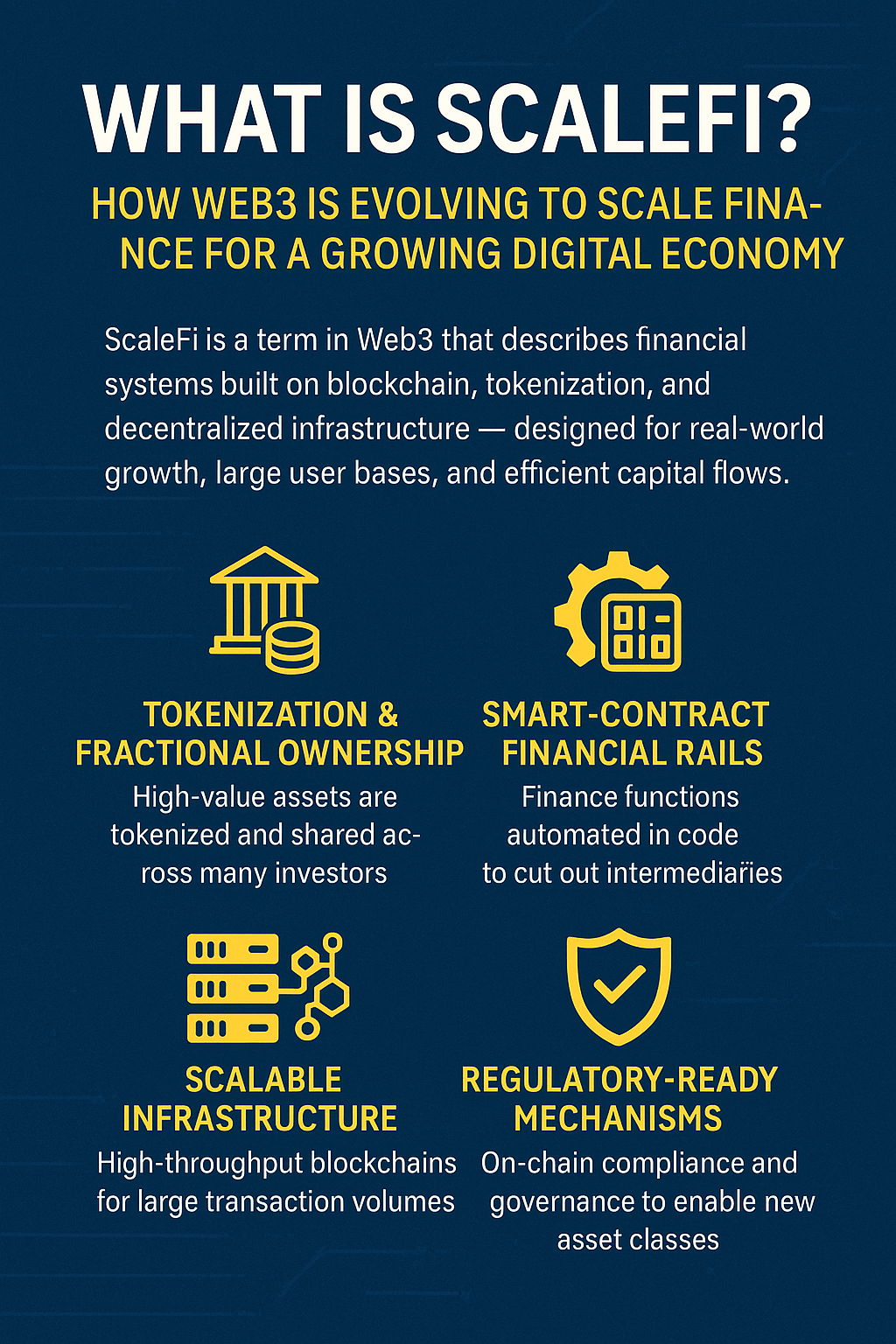
At its core, the term combines “scale” and “finance” to describe financial systems built on blockchain, tokenization, and decentralised infrastructure — designed for real-world growth, much larger user bases, and efficient capital flows.
While traditional DeFi (decentralized finance) focused on early-stage protocols and liquidity niches, ScaleFi looks ahead: How do we scale finance for Web3 to billions of users, assets, and transactions?
The Origins of ScaleFi
Many Web3 financial models were built when the market was smaller, experimental, and centred on crypto-native users. Protocols for borrowing, lending, swaps, and yield farming worked well for niche communities.
However, as Web3 moves toward broader applications, tokenized real-world assets (RWA), embedded finance, consumer wallets, and global markets, the need to “scale finance” becomes critical.
ScaleFi describes that next wave: financial infrastructure designed for mass-market reach, regulatory compliance, and efficient capital deployment across Web3.
How Does ScaleFi Work?
Below are the key elements of ScaleFi in practice:
Tokenization & fractional ownership
Real-world assets, for example, property, infrastructure, and private equity funds, are tokenized on blockchain, letting many investors share ownership and income.
Smart-contract financial rails
Finance functions such as lending, borrowing, syndication, revenue-sharing, and insurance are embedded in code to automate capital flows and minimise intermediaries.
Scalable infrastructure
High-throughput blockchains, Layer-2 roll-ups, side-chains, and interoperable protocols allow large volumes of transactions with lower cost, enabling finance at scale.
Regulatory-ready mechanisms
On-chain compliance, token-based governance, and custody frameworks make it easier for institutional capital and regulated asset classes to participate in Web3.
Let’s look at an Example:
A commercial real-estate building is tokenized; the tokens trade on a compliant platform; smart contracts distribute rental income automatically; thousands of global investors participate, scaling finance beyond traditional private-equity constraints.
Why does ScaleFi matter for Web3 and Business?
Access to Larger Capital Pools
By tokenizing high-value assets and offering fractional participation, ScaleFi opens previously illiquid markets to a broader investor base.
Better Liquidity & Price Discovery
Traditionally illiquid assets (art, real estate, infrastructure) become tradeable, raising transparency and price efficiency.
Lower Costs & Faster Settlement
Smart contract automation reduces the burden of paperwork, middlemen and legacy finance processes. Financial operations can settle near-instantly.
Finance That Scales With Adoption
As Web3 moves beyond early adopters, finance tools must handle mass onboarding, regulatory demands, compliance, custody and high-volume flows — ScaleFi infrastructure anticipates that.
ScaleFi in Action – Case Studies
Tokenised Infrastructure Projects
A renewable-energy plant issues tokens representing future cash flows; many investors buy in, share revenue and trade tokens on secondary markets.
Embedded Finance Platforms
A consumer wallet app includes a tokenized bond-pool; users invest small amounts, receive yield and trade anytime, enabling scaled finance for everyday users, not just institutions.
Private Markets Opened Up
A private-equity fund tokenizes its share units, runs on-chain compliance checks, and allows global accredited investors to participate seamlessly.
- Individual Banks, Keeta Blockchain, and SWIFT are all independently exploring solutions to link financial institutions together and scale for users.
What are the Challenges & Considerations of ScaleFi?
While ScaleFi holds promise, several headwinds persist:
Regulatory complexity
Tokenized assets often sit between securities and commodities, as well as jurisdictions vary.
Infrastructure readiness
Many blockchains still face scaling bottlenecks (throughput, cost, interoperability).
Investor education
Scaling finance isn’t just technical; it means onboarding many users with varying experience and risk tolerance.
Custody & security
Large-scale finance needs institutional-grade custodians, insurance and governance frameworks. They must be Quantum-resistant and impossible to breach.
Liquidity risk
Tokenization doesn’t automatically guarantee liquidity; secondary markets must mature.
The UAE & Web3: A Prime Environment for ScaleFi
The UAE has emerged as a Web3-friendly jurisdiction, with clear regulatory frameworks (e.g., VARA in Dubai, ADGM in Abu Dhabi) and supportive infrastructure for crypto, tokenization and fintech. This environment provides a fertile ground for ScaleFi innovation, enabling businesses to issue tokenized assets, structure compliant offerings and tap global capital from a stable, regulated base. For investors and founders in the region, ScaleFi is not just a buzzword but a strategic opportunity.
Our thoughts
DeFAI is the logical next step in the digital finance evolution, turning decentralized systems into intelligent, self-optimising networks.
For the UAE, this technology can supercharge every sector: enhancing banking, real estate, retail, and government services while supporting the nation’s long-term goals for AI-driven digital transformation.
As more institutions, startups, and regulators explore the potential of DeFAI, those who move early will gain the greatest advantage.
The tools are ready. The vision is clear.
Now is the time for UAE businesses to lead the global shift toward intelligent, decentralized finance.