Regulatory Certainty That Empowers Innovation
The foundation of Dubai’s leadership lies in regulatory clarity.
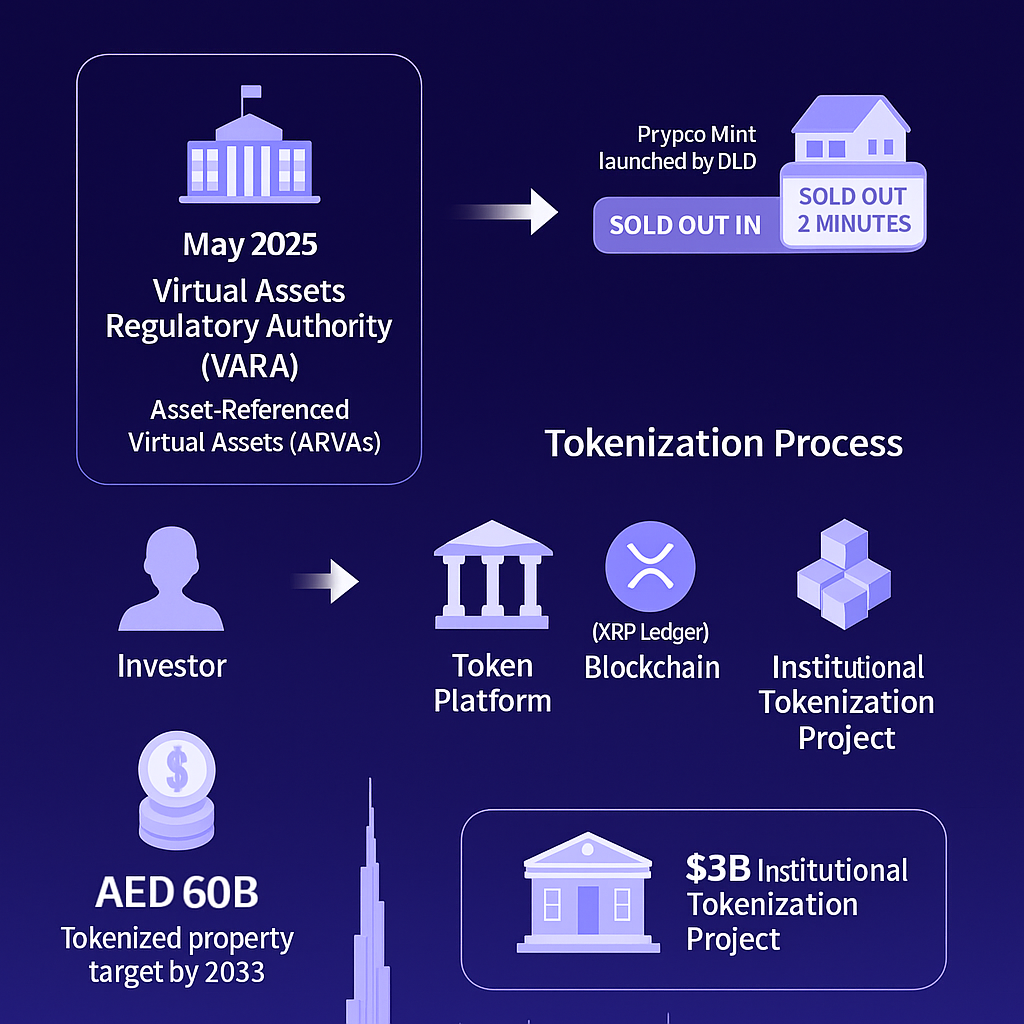
In May 2025, the Virtual Assets Regulatory Authority (VARA) introduced a new asset class, Asset-Referenced Virtual Assets (ARVAs). This legal framework allows the issuance and trading of tokenized real estate while maintaining transparency and investor protection.
Under this model, companies issuing or brokering real estate tokens must obtain official VARA licenses, meet capital adequacy standards, undergo audits, and provide public disclosures.
Rather than limiting innovation, VARA’s system encourages it. By defining how tokenized assets should be issued, governed, and traded, Dubai has positioned itself as a trusted environment for blockchain-based property ownership. As officials from VARA often emphasize, regulation here is infrastructure. The framework that builds investor trust and industry growth.
Real Estate Tokenization in Action
Prypco Mint: Fractional Ownership Made Simple
The Dubai Land Department (DLD), in partnership with VARA, launched Prypco Mint, a fully regulated real estate tokenization platform. It allows investors to purchase digital shares of Dubai properties starting from just AED 2,000 (around USD 545).
Each property token is recorded on the XRP Ledger, while ownership data synchronizes directly with the official DLD land registry. This ensures that blockchain-based tokens are legally tied to physical property deeds.
Investor demand has been overwhelming. In one case, a tokenized luxury villa sold out in less than five minutes. Another property was fully subscribed to in under two minutes, drawing buyers from over thirty-five countries. Analysts forecast that tokenized real estate could represent up to seven per cent of Dubai’s property market. Worth roughly AED 60 billion (USD 16 billion) by 2033.
Tokenization Goes Mainstream
Beyond Prypco, major institutions are moving fast. MultiBank Group, MAG, and Mavryk Finance are launching a USD 3 billion tokenization project, enabling property shares to be purchased for as little as USD 50. The initiative is backed by Fireblocks’ blockchain infrastructure, ensuring security and scalability.
For developers, tokenization unlocks a powerful new way to raise capital. For investors, it creates fractional, liquid access to one of the world’s most lucrative property markets, all under the protection of Dubai’s real estate and financial regulations.
A Digital Ecosystem Built for Growth
Dubai’s ecosystem for tokenization is not an isolated experiment; it is part of a broader national vision for digital transformation.
Through the Real Estate Evolution Space (REES) initiative, DLD launched the Middle East’s first blockchain-based property registry. This initiative supports global participation by allowing investors worldwide to purchase regulated property shares in Dubai, supported by transparent legal documentation and automated smart contracts.
Meanwhile, the UAE’s economic strategy, including the Dubai Economic Agenda (D33) and the Real Estate Strategy 2033, actively integrates blockchain, AI, and digital finance into long-term national growth.
Free zones such as DIFC and ADGM further encourage innovation, offering tokenization-friendly regulations, global banking access, and incentives for Web3 companies.
Together, these initiatives create an ecosystem where innovation thrives within the guardrails of regulatory integrity.
Real Momentum and Expanding Adoption
Real-world results prove the concept is working.
A tokenized villa worth AED 1.75 million sold in under five minutes through Prypco Mint, while two tokenized apartments were snapped up in record time by international investors, seventy per cent of whom were first-time Dubai property buyers.
DLD’s integration with tokenization infrastructure providers ensures that digital tokens link directly with physical land titles. Investors can verify ownership on-chain and off-chain in real time, reinforcing transparency and trust.
Global institutions are also taking notice. Firms such as Apex Group are issuing regulated ERC-3643 real estate tokens, enabling peer-to-peer liquidity and round-the-clock trading. Today, more than USD 17 billion in tokenized real-world assets already circulate on-chain, and Dubai is a key hub driving that growth.
Why the UAE Leads, And What It Means
Dubai’s leadership in real estate tokenization can be attributed to five key strengths:
Element | UAE’s Strategic Edge |
Clear Regulation | VARA’s ARVA framework sets global standards for compliance and investor safety. |
| Government Backing | Platforms such as Prypco Mint are fully supported by DLD, VARA, and the UAE Central Bank. |
Robust Infrastructure | Free zones and blockchain integrations foster international participation. |
Proven Market Fit | Tokenized properties sell out instantly, with rising demand from global investors. |
| Scalable Vision | Dubai’s economic agenda aligns tokenization with long-term growth and smart city goals. |
Dubai is not simply testing tokenization, it is executing it. Billions in assets, seamless legal frameworks, and strong international demand have turned the city into the benchmark for how real-world assets can thrive in the digital economy.
Our Thoughts
Dubai’s approach to real estate tokenization demonstrates what happens when visionary governance meets technological precision. By combining legal clarity, blockchain infrastructure, and cross-sector collaboration, the UAE has built a system that is inclusive, transparent, and globally scalable.
Through initiatives like Prypco Mint and REES, and with the support of VARA, DLD, and major financial institutions, Dubai is transforming property ownership from static and local to dynamic and global.
The result is more than just a new investment model; it is a fundamental shift in how real estate is owned, traded, and experienced. Dubai’s success has become a blueprint for the future of tokenized real estate, proving that the convergence of blockchain and real-world assets is not only possible but profitable, sustainable, and inevitable.